Industrial Automation
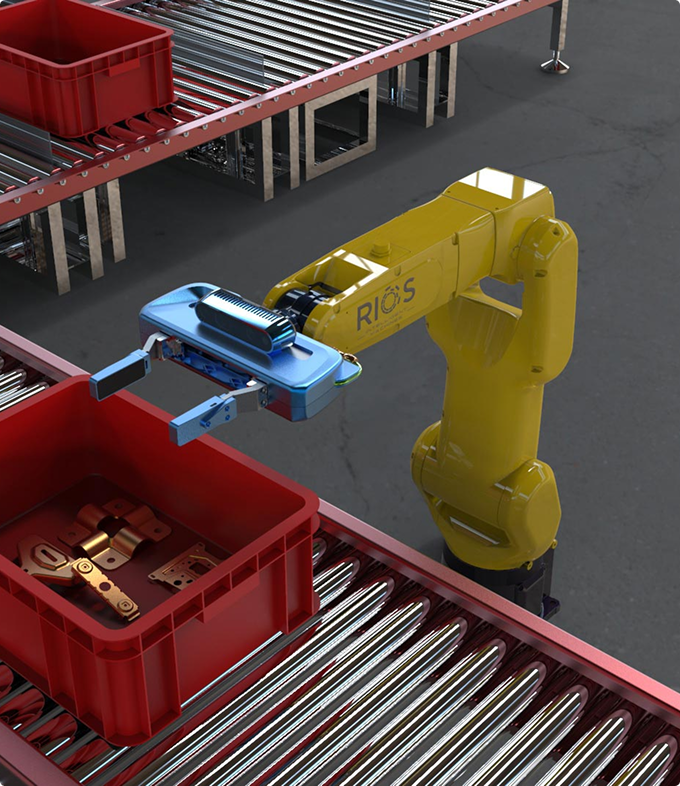
Vision-Guided Arms & Cobots
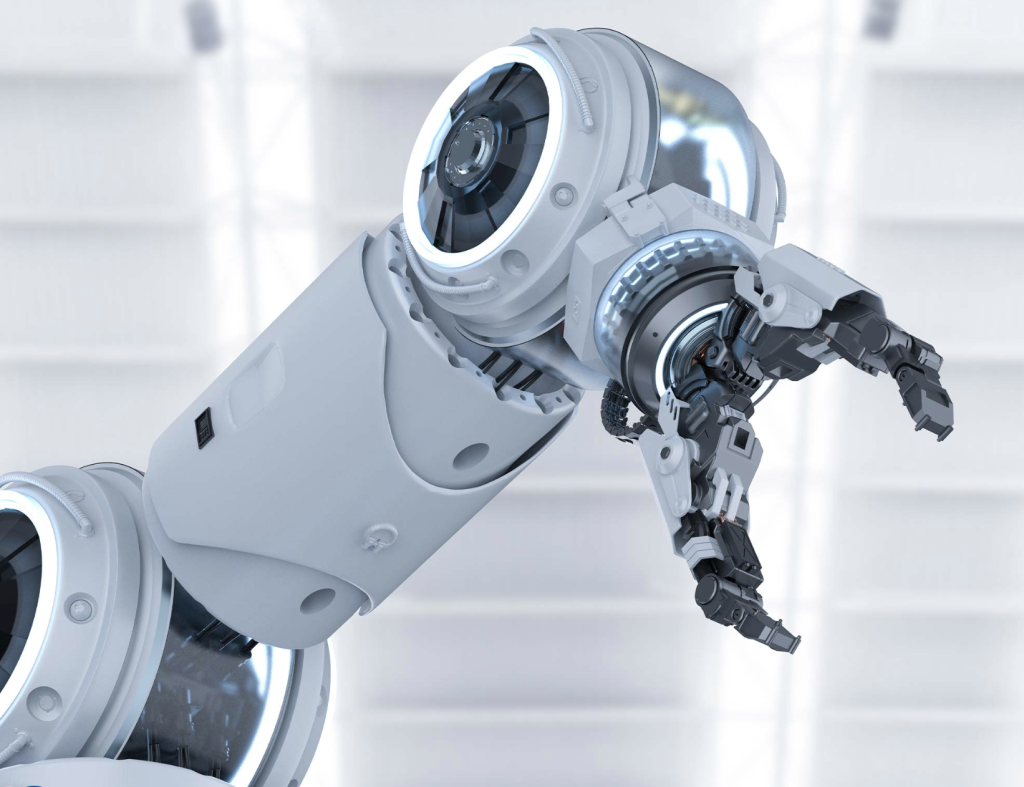
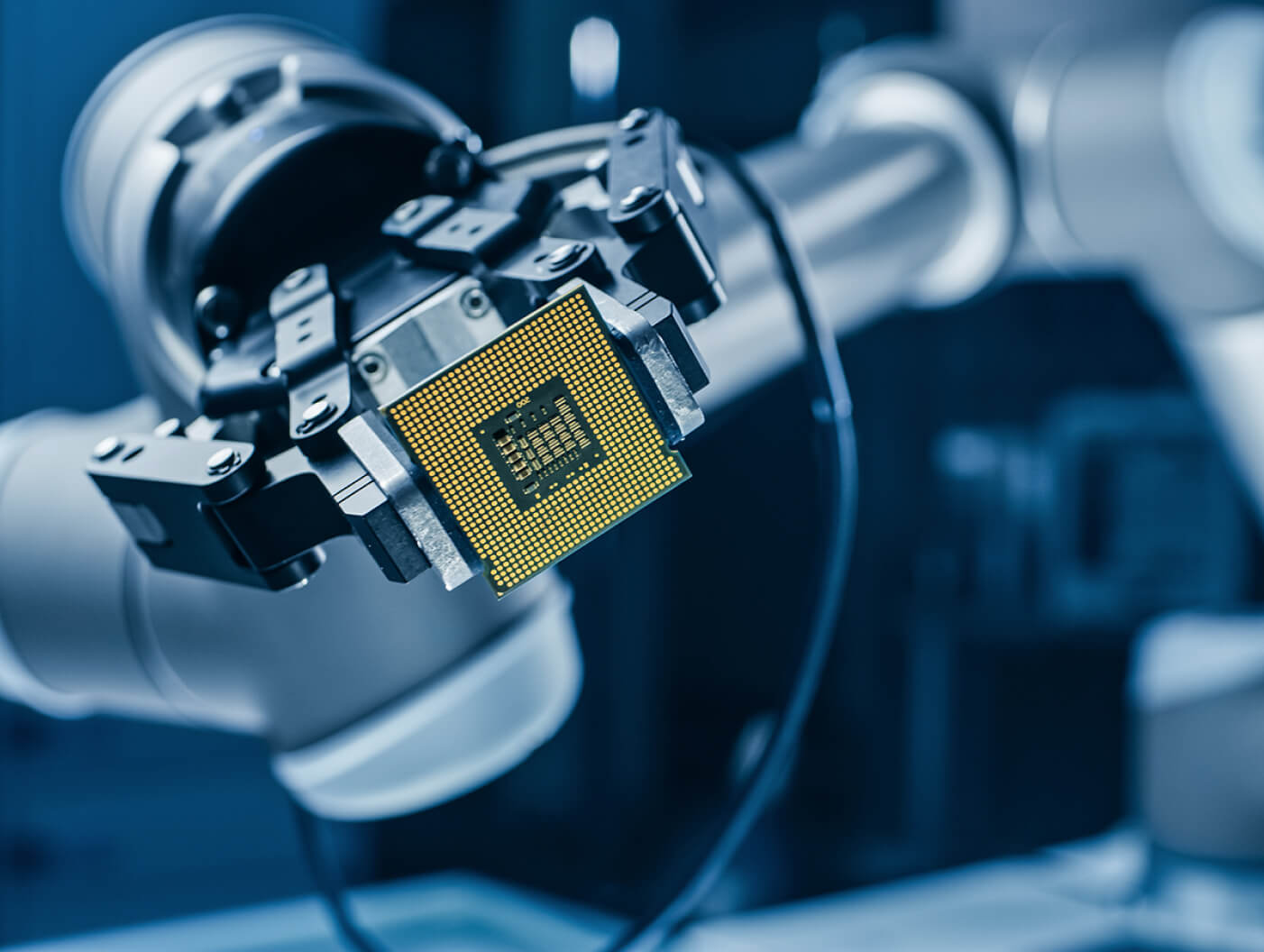
Bin picking, de-racking, fastening, dispensing, and conveyor work have traditionally demanded rigid fixtures and precise indexing to compensate for a robot’s lack of perception. Every worn fixture, drifted part, or shifted bin becomes downtime, rework, or a stopped station.
RealSense-guided systems flip that. Aligning real-time 3D depth data with CAD models lets a robot recognize a part by its spatial geometry rather than its surface appearance, so finish, reflectivity, and cleanliness stop being failure points. That’s what lets automation handle moving lines, cluttered pallets, and mixed part variants, and it cuts the cost of recommissioning for a new part.
Integrators building on RealSense report removing fixtures and staging areas outright. A camera that perceives objects in 3D doesn’t need the positioning infrastructure built to compensate for one that can’t.
Real-Time Tracking & Pose Estimation
A robot that detects a part once and assumes nothing changes fails the moment a bin shifts or a conveyor keeps moving. RealSense depth data feeds continuous 6-DoF pose estimation and trajectory correction into the robot’s control loop with perception-to-motion latency under 80 milliseconds. That’s closed-loop control, not detect-then-move.
Mounting the camera on the robot rather than the station keeps perception aligned with the tool center point, so the system sees what the end effector is about to touch and re-localizes through the motion. For bin picking, TCP calibration aligns the camera to the robot’s coordinate system, letting custom vision models evaluate candidate grasp points against the live depth map.
That holds up where traditional 3D vision breaks: overlapping parts, mobile bins, compact stations with tight sightlines.
Dimensional & Spatial Measurement Across the Line
Point solutions that watch a single workstation miss the context that explains the underperformance. A slow station is usually constrained upstream, not broken itself.
RealSense depth cameras deployed across a full line build a structured spatial map of the floor from 0.5 to 8 meters, with sub-2% depth error, producing the dimensional and positional data that identifies bottlenecks rather than symptoms. A 10-centimeter stereo baseline extends that range far enough to capture full-body motion and complete assembly sequences, not a fixed point in space.
Every camera shares the same spatial reference instead of reporting position relative to itself, so insight scales from one workstation to the line without losing the ability to trace a defect or delay to its source.
Safety & Ergonomic Monitoring
Manufacturing safety programs have long relied on stopwatches, audits, and periodic reviews, tools that catch problems after they’ve cost someone an injury or a shift’s throughput. RealSense-powered vision systems run continuous ergonomic monitoring and unsafe-motion detection without wearables and without interrupting the operator, flagging high-stress motions before they become incidents.
The same 3D data captures how work deviates from standard, not just whether someone was in frame, so supervisors get moment-by-moment visual feedback instead of a delayed report. That drives correction faster than metrics alone, and it scales across hundreds of stations on a line.
That spatial awareness is also what human-robot collaboration depends on. Real-time depth maps feed a cobot’s awareness layer with a person’s position relative to the robot, giving the system what it needs to distinguish collaborative work from a situation that calls for a stop.
Robust Performance in Harsh Industrial Conditions
A vision system that needs a bright, static, dust-free environment doesn’t survive contact with a factory floor. RealSense cameras carry their own active infrared projector, so depth perception holds up independent of ambient lighting, including complete darkness. No re-tuning when the lighting changes between shifts.
Because recognition is driven by geometry rather than appearance, the depth data stays a stable reference no matter what the surface looks like. Industrial-grade housings extend that reliability to robot-mounted deployments, where vibration, cable stress, and constant motion punish a consumer-grade sensor.
Industrial fit also shows up in build time. Integrators standardizing on PoE cameras like the D555 cite field of view, depth-map density, and integration speed as the deciding factors over competing depth hardware, delivering working applications in hours when a customer brings a non-standard request.
An Open Ecosystem: Controllers, Compute, and SDK
Vision-guided automation only scales if it doesn’t lock a plant into one robot brand or one integrator’s stack. RealSense integrates with the major industrial robot controllers — FANUC, ABB, KUKA, Yaskawa, and Universal Robots among them — so mixed fleets and multi-vendor lines aren’t a deployment risk. Camera modules (rather than fixed packaged units) give integrators the flexibility to embed depth sensing into custom, robot-mounted, or edge-compute hardware — pairing naturally with on-device AI compute for real-time inference at the point of work rather than round-tripping to the cloud. That flexibility extends up the stack as well: integrators have built natural-language robot programming layers on top of RealSense depth maps, letting an engineering team describe a task in plain language while the camera’s spatial data supplies the real-time understanding of objects and people that makes the instruction executable. The same open architecture supports a roadmap beyond fixed-position guidance into Autonomous Mobile Robots, where RealSense cameras double as the sensor for Visual Simultaneous Localization and Mapping (VSLAM), and intelligent pick-and-place systems that share the same depth-camera baseline across a company’s broader automation portfolio.
Built on the open-source librealsense SDK, the same depth pipeline that drives pose estimation and part recognition also feeds spatial-analysis and measurement tooling, so a single sensor and software stack supports guidance, tracking, measurement, and safety monitoring without stitching together separate systems for each.

Proven at Scale
RealSense-powered industrial automation is running in live production today, not pilots. Vision-guided robotic cells built on the RealSense D435 are deployed in more than 70 factories worldwide, with reported ROI as fast as three months and one automotive retrofit reaching return on investment in roughly three months. In live production, results include pick success rates up to 95% with sub-one-second pick cycles, a 70% improvement in dispensing cycle time, a 30% reduction in pick-and-place cycle time, and a 91% reduction in tightening rejects — with one facility reporting a 97% drop in line breakdowns after deployment. On the visibility and safety side, RealSense D455 modules paired with edge AI compute are deployed across automotive OEM and supplier lines — including a Toyota facility — mapping every process on every cycle rather than sampling a workstation at a time. For a nearly six-decade-old industrial automation builder, standardizing on RealSense’s PoE-connected D555 has cut bin-picking application delivery from weeks to days, and specific customer requests from days to hours.